The short answer
Air conditioning does not make cold — it moves heat. A refrigerant fluid is pumped round a sealed loop. Inside, it absorbs heat from your room air as it evaporates; outside, a compressor squeezes it and it releases that heat as it condenses. The cooled, dehumidified air is blown back into the room. The same loop run in reverse provides heating. Because it pumps heat rather than burning fuel, a unit can deliver several units of cooling or heating per unit of electricity used.
Almost every air conditioner — from a £300 portable to a whole-building system — works on one principle: a vapour-compression refrigeration cycle that transports heat from where you don’t want it to where you don’t mind it. Understanding the four parts of that loop explains why some systems are quiet and efficient, why they drip water, why only certified engineers may touch the refrigerant, and where your running costs come from. This is the overview page; each section links to a deeper guide.
Air conditioning at a glance
- Core principle Moves heat, doesn’t create cold
- Key parts Compressor, condenser, expansion valve, evaporator
- Working fluid A fluorinated refrigerant in a sealed loop
- Typical efficiency Several kW of cooling per kW of electricity
- Heating too Reverse the cycle (air-to-air heat pump)
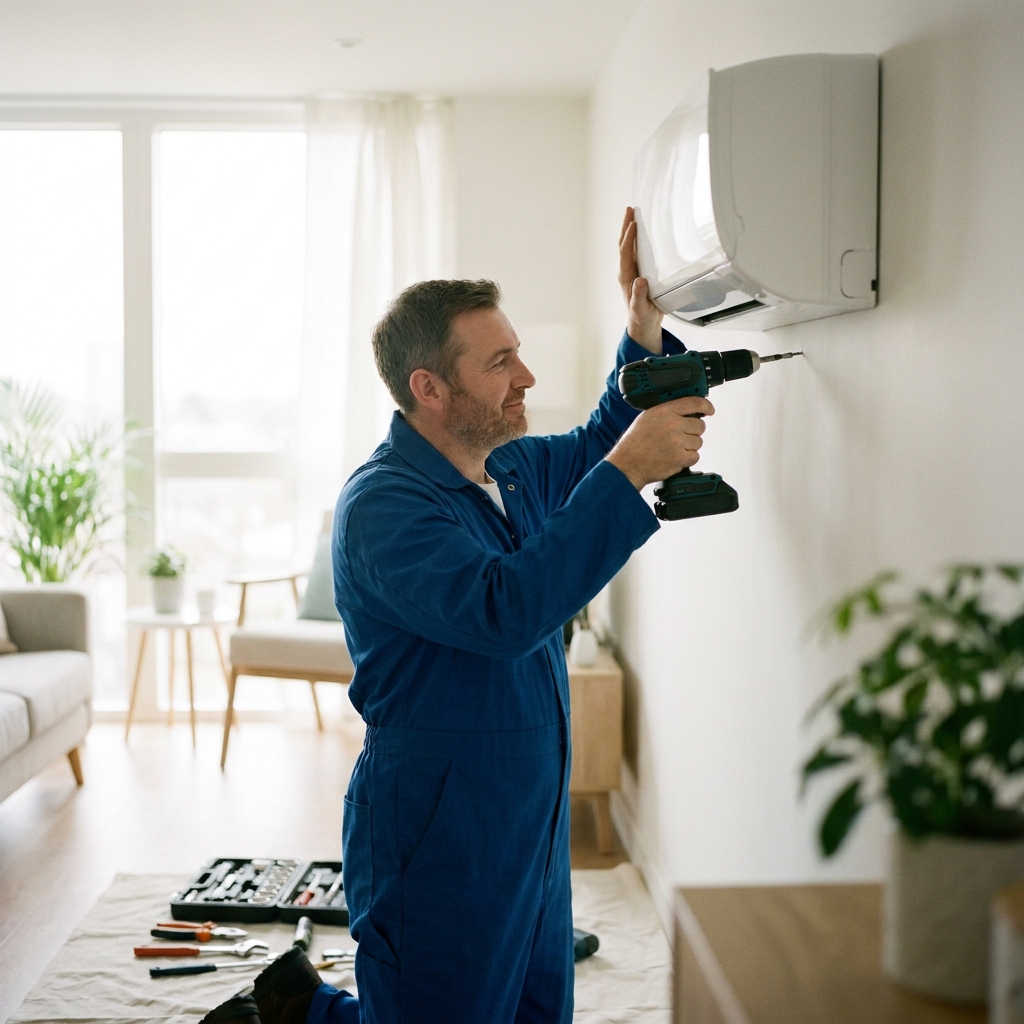
- Who may install An F-Gas-certified engineer only
The big idea: heat is moved, not made
The single most useful thing to understand about air conditioning is that it does not generate cold. There is no such substance as “cold”; there is only heat, and the absence of it. An air conditioner is a machine for picking heat up in one place and putting it down in another. To cool a room, it collects the heat in the room air and carries it outside, leaving the air behind cooler and drier. This is exactly what a fridge does to keep food cold, and what a heat pump does to warm a house — the same machine, pointed in different directions. Because the system spends energy transporting existing heat rather than burning fuel to create it, it can move several times more heat energy than the electricity it consumes.
The four parts of the refrigeration cycle
An air conditioner contains a sealed loop of pipework holding a refrigerant — a specially chosen fluid that boils and condenses at convenient temperatures. Four components do the work, and the refrigerant changes state as it travels through each one. The clever trick is that a fluid absorbs a large amount of heat when it boils from liquid to gas, and releases that same heat when it condenses back to liquid. The system simply arranges for the boiling to happen indoors and the condensing to happen outdoors.
- Evaporator (the indoor coil): low-pressure liquid refrigerant boils into a gas here, pulling heat out of the room air that a fan blows across it. This is where the cooling you feel actually happens.
- Compressor (in the outdoor unit): squeezes the gas to high pressure and temperature so its heat can be shed outside. This is the part that uses most of the electricity, and the part that makes most of the noise — which is why it lives outdoors.
- Condenser (the outdoor coil): the hot, high-pressure gas releases its heat to the outside air and condenses back into a liquid. This is why the outdoor unit blows warm.
- Expansion valve: drops the liquid’s pressure suddenly, which cools it sharply so it arrives at the indoor coil cold and ready to absorb heat all over again.
The cycle repeats continuously, ferrying heat from inside to outside for as long as the unit runs. Run the same loop the other way — which a reverse-cycle unit does with a four-way valve — and heat is carried indoors instead, which is how the same box heats your room in winter. For a closer look at the indoor stage, see how air con cools a room.
| Stage | What happens | State of refrigerant |
|---|---|---|
| Evaporator (indoor) | Absorbs room heat | Liquid → gas |
| Compressor (outdoor) | Raises pressure & temperature | Low-pressure gas → hot gas |
| Condenser (outdoor) | Rejects heat outdoors | Gas → liquid |
| Expansion valve | Drops pressure, cools fluid | Warm liquid → cold liquid |
Why it is so efficient — and what it costs
A gas boiler can never be more than 100% efficient, because it turns fuel into heat and some always escapes up the flue. A heat pump breaks that ceiling: it spends a little electricity to move a lot of heat that already exists in the outdoor or indoor air, so it can deliver several units of heating or cooling for each unit of electricity used. In practical terms, a typical 2.5 kW split system draws roughly 0.6–1.0 kWh per hour when cooling, which at a unit rate around 25p/kWh works out at about 15–25p per hour to run. That makes it considerably cheaper to run than many people expect. The Energy Saving Trust treats air-to-air systems as an efficient form of electric heating and cooling when they are correctly sized and sensibly used. Efficiency in the real world depends far more on right-sizing and good habits — shutting doors and windows, using a sensible set temperature — than on the badge on the box.
Cooling, dehumidifying and that drip of water
There is a useful side effect to the indoor stage. As warm room air passes over the cold evaporator coil, the water vapour it carries condenses onto the coil — the same way a cold glass of water sweats on a summer day. That is why an air conditioner dehumidifies as it cools, and why it produces a steady trickle of condensate that drains away through a small pipe. Drier air feels markedly more comfortable even before the temperature has dropped much. The flip side is that a blocked condensate drain is a common fault, causing an indoor unit to start leaking water into the room.
The main system types — one cycle, many shapes
That same refrigeration cycle is packaged into several formats to suit different homes and budgets. A full range of system types exists, but the common domestic choices are:
- Single split: one outdoor unit paired with one indoor unit, cooling one room. Typically £1,500–£3,000 installed, and the least disruptive fixed system.
- Multi-split: one outdoor unit feeding several indoor units across several rooms, often £3,000–£6,000 or more — see split vs multi-split.
- Portable: a self-contained box on castors with a hose to a window, £300–£600, less efficient and noisier because the compressor sits in the room.
- Ducted: a hidden indoor unit feeding rooms through concealed ducts and grilles — see ducted air conditioning explained.
Most modern fixed units are inverter-driven, varying compressor speed to hold a steady temperature rather than switching fully on and off. That cuts both running cost and noise, and is the standard today.
What this means for you
Knowing the cycle helps you make good decisions. Size the unit to the room so the compressor is neither over-worked nor short-cycling; keep the outdoor coil clear of leaves and obstructions so it can shed heat properly; and service it once a year so the refrigerant charge, the filters and the condensate drain all stay healthy. A correctly installed sealed system should never need its refrigerant “topped up” — if it is low, there is a leak to find, covered in air con refrigerant explained. This page is general information, not a site-specific survey or a substitute for a quote from an F-Gas-certified installer. From here you can compare air conditioning against a heat pump, or look at what suits a home.
Frequently asked questions
Does air conditioning create cold air?
No. It removes heat from the room and pumps it outside; the air left behind is cooler and drier. Nothing actually generates cold.
Can air conditioning also heat a room?
Yes. Reverse-cycle units run the refrigeration loop backwards to bring heat indoors, acting as an air-to-air heat pump for efficient heating.
Why does my air conditioner drip water?
Moisture from the room air condenses on the cold indoor coil. That condensate normally drains away; a blocked drain causes leaks indoors.
Am I allowed to install air conditioning myself?
You can buy a plug-in portable unit, but any system containing fluorinated refrigerant must legally be installed and charged by an F-Gas-certified engineer.
Sources & further reading
- gov.uk — The Fluorinated Greenhouse Gases Regulations 2015 (GB F-gas)
- gov.uk — DEFRA guidance on F-gas and who may handle refrigerant
- Energy Saving Trust — air-to-air heat pumps and electric cooling
- HSE — safe handling of refrigerants and pressure systems
This guide is general information, not a site-specific survey or a substitute for a quote from an F-Gas-certified installer. Installation, servicing and refrigerant handling are legally restricted to F-Gas-certified engineers.